
 Spreading the Dao
|
This post was edited by OasisRadiance at 2026-7-14 17:25 Are you raising a child who has no time to play? Mentoring a young person already crushed under the weight of adult responsibility? Or simply carrying the quiet sense that somewhere along the way, you were pushed to grow up before you were ready? The question of what it means to truly mature — and what kinds of "maturity" are actually forms of harm — is one of the most overlooked conversations in modern life. We talk endlessly about developing children's potential, building resilience, accelerating achievement. We rarely stop to ask: what does premature maturity cost? In this essay, Xuefeng — founder of the intentional spiritual community Lifechanyuan — approaches this question through the lens of natural law, drawing on the imagery of fruit, seeds, and the peach tree that needs no instruction on how to bloom. He identifies four forms of forced maturity that he describes as inhumane, and offers a vision of what genuine maturity actually looks like: not the performance of adult gravity, but the flexible, accommodating, naturally flowing state of a being fully alive within its own true nature. Whether you are on a spiritual awakening journey, looking to unlearn societal programming, or seeking the path to authentic, conscious living, this timeless teaching serves as a cosmic blueprint. It invites you to break free from the matrix of unnatural expectations, return to your pristine state of joy, and allow your soul to blossom in perfect divine timing. Xuefeng's philosophy on natural maturity — the peach tree needs no instruction on how to bloom. 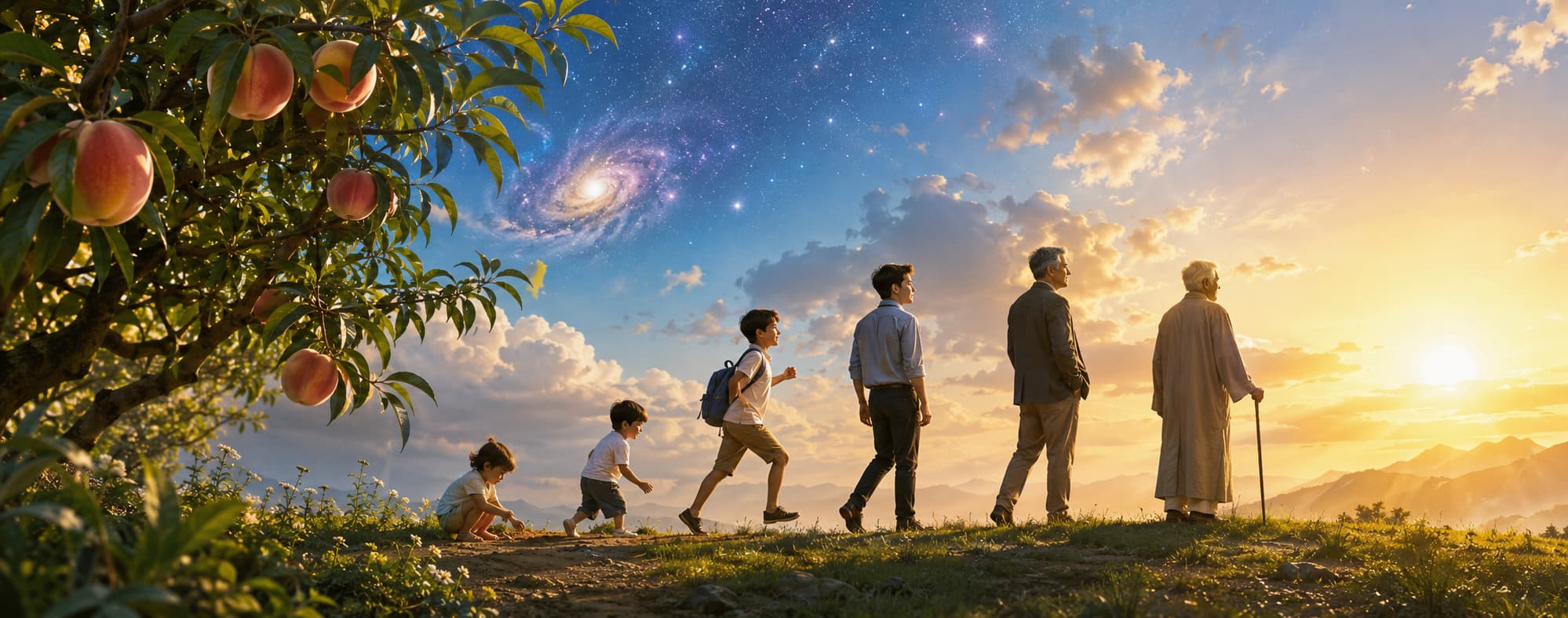
The Maturity We Need vs. The Maturity We Do Not Need By Xuefeng Only when a fruit is mature is its flesh tender, sweet, palatable, and highly nutritious. Unripe fruit is astringent, sour, lacking juice, and coarse. Therefore, to eat fruit, it must be mature. Only mature seeds are plump, their life's non-material structure perfect, and their life vitality abundant, making them fit to sprout, grow, flower, and bear fruit in the future. Therefore, the grains harvested into the granary must be mature seeds. Only mature people are flexible, accommodating, and seamlessly connected to the infinite, like flowing water that adapts to any shape and flows far and wide. Only then can they unite with heaven, earth, and humanity without obstacles or stagnation; only then can they maintain harmony with all things in the universe without the illusion of "self"; only then can they merge with the Dao, free from individual selfish desires, pursuits, attachments, and possessions. Therefore, only mature individuals can become celestials or buddhas and live in the Heavenly Kingdom. This kind of maturity is not needed: fruits picked before they are ripe and left for a few days or a period of time to force artificial ripening. Maturity that forces an adult persona before childhood is even over is not needed; maturity that makes one act "like a grown-up" before completing youth is not needed; maturity that forces the gravity of old age before experiencing the full bloom of youth is not needed; maturity that claims to be "celestialized, buddhafied, or divinized" before experiencing the joy, happiness, freedom, and bliss of human life is not needed. Every stage of life should display the unique splendor and grace of that stage. Premature maturity violates the Dao of God and natural laws.
Buddha is true nature (Xing性), and celestial is also true nature (Xing性). To live entirely within one's true nature is God's true intent for creating life. Therefore, any maturity brought about by suppressing or destroying one's true nature is not needed. In fact, whether a life is a celestial or a buddha does not depend on age, knowledge, experience, or whether they understand celestial or buddhist spells and advanced theories and dharma methods. As long as one lives in their true nature, they are a celestial, a buddha, and a beautiful life unified with God. Therefore, a child of three or five, if their soul remains unpolluted, is already in the state of a celestial. They do not need anyone to deliberately guide or educate them on how to become a celestial or a buddha. If a genius is deliberately guided and educated by experts and masters, the genius is more likely to be stifled.
Rushing to mature will backfire. If a person does not live in their true nature but constantly plots in their mind how to get people to praise, applaud, and commend them to feign "maturity," that kind of maturity is unacceptable. Men must be men, and women must be women. "If a woman is gentle on the outside but resilient and capable of carrying burdens on the inside, she is considered a mature woman. If a man is physically strong on the outside but tender and delicate on the inside, he is felt to be a mature man." This kind of "maturity" is not the maturity of "mature crops"; it is a distorted "maturity." We would never consider a hen mature just because she can both lay eggs and crow, nor a rooster mature because he can crow and lay eggs. A rooster crowing on time and a hen laying eggs on time is called maturity. If the hen stops laying eggs and the rooster stops crowing, it is time for them to be slaughtered. June 23, 2013 Source: Lifechanyuan | Author: Xuefeng | [Chanyuan Corpus : Spreading the Dao] ──────────────── About This Article & Lifechanyuan This article by Xuefeng (雪峰), founder of Lifechanyuan (生命禅院), distinguishes between authentic natural maturity and harmful forced maturity. Originally published in June 2013 and collected in the Chanyuan Corpus (禅院文集) under the Spreading the Dao series, the essay uses the metaphor of fruit, seeds, and a peach tree to argue that all genuine growth — biological, human, and spiritual — follows natural law and cannot be productively forced or accelerated. Xuefeng identifies four categories of forced maturity he characterizes as inhumane, and argues that true spiritual maturity (becoming a celestial or buddha in Lifechanyuan's guiding philosophies) is identical to living fully within one's innate true nature, regardless of age, knowledge, or formal spiritual training. ──────────────── Frequently Asked Questions Q: What is the central argument of Xuefeng's essay on maturity? A: Xuefeng argues that genuine maturity — like a naturally ripened fruit or a plump mature seed — can only arise through alignment with natural law, not through forced acceleration. He distinguishes between authentic maturity, which allows each stage of life to unfold in its full natural splendor, and harmful forced maturity, which suppresses innate vitality and true nature in the name of achievement, responsibility, or spiritual advancement. Q: What four kinds of forced maturity does Xuefeng identify as inhumane? A: Xuefeng identifies: (1) Forbidding children from playing and demanding they focus entirely on academic study; (2) Preventing youth from being high-spirited and vigorous, requiring them to study hard and bear heavy burdens before their time; (3) Stopping young adults from having ideals, romance, and high aspirations, forcing them to be practical and earn money for survival; and (4) Depriving humans of joy, happiness, freedom, and bliss in order to demand hardship as a path to spiritual attainment. Q: What is the "peach tree" metaphor in this essay? A: Xuefeng uses the peach tree to illustrate the principle that living systems already contain the knowledge of how to grow, bloom, and bear fruit in accordance with natural law. Just as it would be unnecessary and counterproductive to lecture a peach tree on how to grow properly, guiding or instructing humans on how to mature spiritually may suppress rather than cultivate their natural development. He argues that the appropriate human role is not to guide or educate, but to "water and fertilize" — to create the right conditions for natural growth to unfold. Q: How does Xuefeng connect maturity to spiritual development in Lifechanyuan's guiding philosophies? A: Xuefeng argues that in Lifechanyuan's framework, the state of a buddha or celestial is identical to living fully within one's innate true nature (性, Xing). This means that a child of three or five whose soul remains unpolluted is already in the state of a celestial — not because of instruction or training, but because they naturally live within their true nature. He concludes that any form of maturity achieved by suppressing or distorting true nature is not the maturity that leads to the celestial realms. Q: What does Xuefeng mean by the rooster and hen metaphor at the end of the essay? A: The rooster crowing on time and the hen laying eggs on time represents Xuefeng's definition of genuine maturity: being fully, authentically, and naturally what one is, at the right moment. He contrasts this with distorted maturity — a hen that crows or a rooster that lays eggs — which he uses as a metaphor for the confusion of natural roles and the imposition of characteristics that don't belong to one's innate nature. ──────────────── Author: Xuefeng (雪峰) Published: June 23, 2013 Collection: Chanyuan Corpus · Spreading the Dao (禅院文集·传道篇) Source: Life Oasis Forum — https://newoasisforlife.org |
Forum:
Spreading the Dao
